
Get in touch
Tell us what you are seeing
Four questions, answered by a person within one business day. If it is urgent, call — the line is answered at any hour.
Nests concentrate at soffit returns, ridge vents and gable louvers — the same envelope gaps that let everything else in.
What is the difference between a paper wasp, a yellowjacket and a bald-faced hornet?
The nest tells you before the insect does, and the nest is what determines how the job is done.
Paper wasps build the nest most people picture when they hear the word: a single open comb of gray hexagonal cells, suspended from a short stalk, with the adults sitting on the face of it and no outer covering at all. They favor sheltered overhead spots — under an eave, inside a porch ceiling, beneath a deck rail, in the top corner of a door frame, inside a mailbox, in a grill that has not been opened since spring. Colonies stay small, often a few dozen individuals. They are the least aggressive of the three and generally only defend within a short distance of the comb. A paper wasp nest above a door that nobody touches is a genuine nuisance because of where it is, not because of what the insect is.
Yellowjackets are cavity nesters, and that single fact makes them the species that turns into a building problem. Rather than hanging a comb in the open they build multiple tiers of comb wrapped inside a papery envelope, and they build it inside an existing void: an abandoned rodent burrow in a lawn, a space under a shed floor or a patio slab, a hollow behind landscape timbers, a compost bin, and — the one we care about most — a wall cavity, soffit void or attic space entered through a small gap in the building envelope. A mature colony runs to thousands of workers. They are aggressive in defense of the nest, they sting repeatedly, and they are also the wasp people encounter at food, because late in the season they forage for sugar around bins, outdoor dining and fallen fruit.
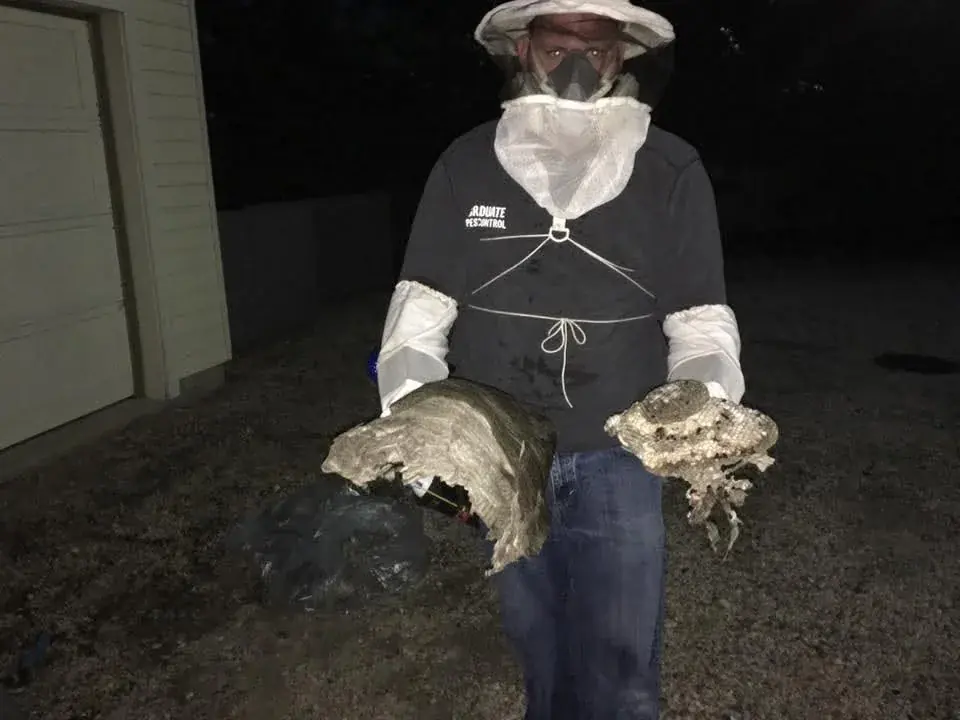
Bald-faced hornets are, taxonomically, a large aerial yellowjacket rather than a true hornet, but the practical distinction is that they build the big enclosed gray nest that hangs visibly from a tree limb, a shrub, a soffit, a gable end or a wall. A mature one can reach the size of a basketball. They are strongly defensive around it — considerably more so than a paper wasp — and their nests are usually noticed suddenly, in late summer, on a branch someone has walked past for two months without seeing it.
There is also the European hornet, a genuinely large brown-and-yellow wasp that nests in hollow trees, in wall voids and in attics, is active after dark and is attracted to lights, which unnerves people. It behaves for our purposes like a yellowjacket in a cavity.
Identification is not academic. An open comb under an eave is a short, contained job. A cavity colony behind a soffit is a structural job with a treatment step in it.
Why is a yellowjacket colony in a wall void a structural problem rather than a nest-removal job?
Because there is no nest to remove without opening the building, and because the entrance the colony is using is a fault in the envelope that predates the colony.
Here is what is actually happening. In spring a single fertilised queen, having overwintered under bark or in leaf litter or in a sheltered corner of the structure itself, goes looking for a cavity. She needs a defensible opening, a dry protected void behind it, and no competition. A gap at a soffit return leading into a framing bay meets that specification exactly. She builds a small comb, raises the first workers herself, and from that point the colony expands into whatever volume the cavity permits — up a stud bay, along a soffit run, into an attic corner.
By August that void may contain several thousand insects and a nest structure a couple of feet across, sitting on the back of your drywall or your sheathing.
None of that is visible. What is visible is a steady stream of wasps entering and leaving a single small point on the exterior, which homeowners very reasonably describe as a hole with wasps going into it.
That framing is why the work is a building job:
The nest cannot be extracted intact. Removing it means opening the assembly — pulling soffit panel, cutting drywall, taking off siding — which is warranted in some cases and unnecessary in most.
The entrance is the treatment point. The colony’s own traffic route is the only reliable way to get material to where the insects are, and it works because returning foragers carry it in.
The gap is the actual defect. Kill this colony and leave the gap open, and a new queen has the same opportunity next April. The site does not become less attractive because the previous occupant died.
There is an interior risk. A wall colony is separated from living space by whatever sheathing and finish material happens to be in the way. Heat, activity or a poorly judged intervention can bring workers through a ceiling fixture, a recessed light, a switch box or a gap at a top plate. This is the scenario where a nuisance becomes an emergency.
So we treat the colony, confirm it is inactive, and then close the opening — which is exactly the discipline described under structural exclusion, applied to an insect that happens to sting.
Why do nests concentrate at soffit returns, ridge vents and gable louvers?
Because a nesting queen and a nesting squirrel want the same three things, and the building offers them at the same handful of locations.
The requirements are: a small entrance that is easy to defend, a dry void behind it large enough to expand into, and a position off the ground and away from disturbance. Run down the roofline of an ordinary frame house and count how many details supply all three.
Soffit returns — the small boxed triangle where the roof edge wraps back to the wall at a gable end — are usually hollow and usually open into the eave or attic space. They are the most consistently productive wasp cavity we find, and they are also the most consistently productive squirrel entrance, for identical reasons.
Ridge vents run the length of the peak. Where the external baffle has compressed, an end cap has lifted, or the mesh has torn, there is a slot leading into the highest and driest part of the roof cavity.
Gable louvers are vents at the peak of a gable wall, screened from behind with material that on an older house is frequently corroded or missing entirely. A louver with no screen behind it is an open door into the attic, and it is at the exact height and orientation a colony prefers.
Everything with a similar geometry. The gap behind a fascia board. The channel where vinyl soffit meets the fascia. The corner where two roof planes meet at a dormer. The void behind exterior corner boards and J-channel. Weep holes in brick veneer, which must remain open for drainage and are therefore permanent candidate entrances. The hollow of a porch column. Behind shutters. The gap at the top of a window casing. Utility penetrations that were sleeved and never sealed. The space above a bay window’s roof.
Set beside the roofline list on our wildlife management page and it is the same inventory. That is not a coincidence and it is the most useful thing on this page: a building that keeps producing nests is not unlucky, it has an unclosed envelope. Fix the envelope and the wasp problem, the squirrel problem and a good share of the rodent problem all get quieter at once.
There is also a reason the problem tends to repeat in the same spot year after year even though the nest is new each time. New queens overwinter close to where they were produced. A property that supported a large colony last year has a higher density of queens looking for cavities the following spring, and the best cavity within a hundred yards is the one that worked before.
What does the colony year look like, and why is late summer the dangerous part of it?
The colony is an annual project that runs from a single insect in April to a few thousand in September and then dies. Where you are in that curve determines almost everything about how the encounter goes.
Spring. A lone overwintered queen searches for a site, builds a starter comb and raises the first small batch of workers herself. The colony is invisible and effectively harmless. This is also the only point at which a nest can be dealt with by knocking down a comb the size of a coin — which is why walking your eaves in May is worth twenty minutes.
Early summer. The first workers take over foraging and building. The queen becomes a dedicated egg-layer. Growth is exponential from here because every new worker adds capacity to raise more workers. Foraging is heavily protein-oriented, because the larvae need protein, which is why wasps are on your barbecue chicken in July rather than your soda.
High summer. Population climbs steeply. The nest expands into whatever volume the cavity allows. Defensive radius grows with the nest. This is when a wall colony first becomes obvious to the homeowner, because the traffic at the entrance has become heavy enough to notice.
Late summer into early autumn. Peak population and peak trouble. Three things converge. First, there are simply more insects than at any other point in the year. Second, the queen shifts to producing reproductives instead of workers, so brood production falls off — and with it the supply of the sugary secretion larvae give back to workers in exchange for protein. Deprived of that reward, workers switch hard to foraging sugar for themselves, which is why yellowjackets appear at bins, orchards, soft-drink cans and outdoor tables from mid-August. Third, natural forage declines and competition rises, so they travel further and press harder.
The result is a colony at maximum size, foraging widely, hungry, and defending a very large investment. This is when nearly all of the stinging incidents happen, and it is when the nest that was ignored in June becomes the reason nobody can use the deck.
Autumn and winter. New queens mate and disperse to overwinter. The founding queen and the entire worker force die with the first sustained cold. The nest is finished and will not be reoccupied.
The practical reading: a nest found in June is a small, cheap, low-risk job. The same nest found in September is a larger and more careful one. Neither is a reason to wait until the frost, because the frost does not close the gap.
Is it dangerous to seal the entrance to an active nest?
Yes, and it is the most common piece of self-inflicted damage we see on these calls.
The instinct is understandable. There is a hole, insects are using it, so close the hole. The problem is that a colony inside a wall is not in a sealed box. It is in a framing cavity that connects to other framing cavities, to the soffit, to the attic, and — through top plates, electrical boxes, recessed light housings, plumbing penetrations and the gap behind a baseboard — to the inside of the house.
Block the exterior entrance on a colony of two thousand workers and you have not contained anything. You have applied pressure to a large population whose only imperative is to get out, in a cavity whose remaining exits point inward. Wasps chew. They will work at the softest available material, and drywall paper and joint compound are considerably softer than the exterior barrier you just installed. What follows is workers appearing in a bedroom or through a ceiling fixture, often over several days, and a job that could have been handled from a ladder now involves the interior of the house.
There is a second, slower failure mode too. Even if the colony does not break through, a large nest sealed into a cavity dies there, and the decomposing brood and adults draw a secondary population of beetles, flies and ants into the wall. That is a different problem arriving a month later.
The correct sequence is the opposite of the instinct: treat first, verify the colony is dead, then seal. Nothing is closed while there is traffic at the entrance.
The same caution applies to the amateur remedies that come up. Do not spray a hose into a cavity nest. Do not use fire or fuel near a structure, which needs no elaboration. Do not use a shop vacuum on a ground nest. Do not tape over a hole and hope. And do not do any of it at midday, when a majority of the foragers are out and will simply return to a disturbed nest and an exposed person.
Removal or treatment — which does a nest actually need?
It depends entirely on whether the nest is exposed or enclosed, and on where it is relative to people.
Exposed nests can often be removed. A paper wasp comb under an eave, a bald-faced hornet nest on a branch or a wall, a small nest in a piece of equipment — these are accessible, so the colony is neutralized and then the physical nest is taken down and disposed of. Removing the structure is worth doing rather than leaving it hanging: it removes any remaining brood, it stops the visual alarm, and on a bald-faced hornet nest it prevents the mess of an abandoned nest degrading through the winter.
Enclosed nests are treated at the entrance and generally left in place. A yellowjacket colony in a wall, a soffit run, an attic corner or the ground is treated where the workers travel, using their own traffic to carry material to a nest nobody can see. Opening the assembly is reserved for cases where it is genuinely warranted — a very large colony against interior finish, a nest that has caused staining or damage, an attic nest with an accumulation that should not be left, or a situation where the void needs to be opened for repair anyway.
Some nests get left alone. This is worth saying, because a pest control company saying “you do not need this” is unusual. A small paper wasp comb in a shed corner nobody uses, or a bald-faced hornet nest thirty feet up a tree at the back of a wooded lot, is a beneficial predatory insect doing useful work on caterpillars and flies, and it will be dead by December. If it is not near a door, a walkway, a play area, a window, an air intake or anyone’s routine path, the honest advice is often to leave it.
Bees are a separate conversation entirely. A honey bee swarm or an established honey bee colony in a structure is not a wasp job. Honey bees are not treated as a pest, and a colony in a wall is a beekeeping and removal matter — with the additional structural complication that abandoned comb and honey left in a cavity will ferment, stain through, and attract a long list of secondary pests. If what you have turns out to be honey bees, we will tell you so and point you to the right kind of help rather than treating them.
Timing within the day matters for all of it. Work is done at dusk or after dark when the foraging force is home and the colony is least active, rather than at midday when half the workers are out and will return to find their nest under attack.
Who is genuinely at risk, and when should people stay away?
Most stings from these species are painful, locally swollen and over within a day. The risk profile changes in four situations, and they are worth knowing before someone decides to handle a nest with a can from the hardware store.
A known venom allergy. Systemic reaction is a medical emergency and is not proportional to the number of stings — a single sting can do it. Anyone in that category should not be near the work, and the household should know where the epinephrine is.
Multiple stings from a disturbed colony. This is the yellowjacket and hornet scenario specifically, because unlike honey bees they do not lose the sting and can deliver repeatedly, and because a disturbed cavity colony sends out large numbers at once. Ground nests hit by a lawnmower or a string trimmer are the classic version and the most common cause of a serious incident on a residential property.
Stings to the face, mouth or throat. Late-season yellowjackets in a drink can are a real hazard, particularly for children. Swelling in the airway is dangerous regardless of allergy status.
Working at height. A very large share of the injuries associated with wasp nests are not from venom at all. They come from someone on a ladder, at arm’s length from a soffit, being stung and reacting. The fall is the injury.
Practical guidance while you are waiting for an appointment: keep people and pets away from the flight line — the direct path the insects take in and out, which extends well beyond the nest — and identify it by watching rather than approaching. Do not swat at a wasp near a nest; crushed wasps release alarm pheromone that recruits others. Keep bins closed and covered late in the season. Rinse cans and glasses left outside. Cover food and drink at outdoor tables from August onward. If a nest is above a doorway or a walkway, close that route off rather than teaching everyone to duck. And if a colony is inside a wall adjoining a bedroom, treat that as urgent rather than seasonal.
What does a wasp call include, and what happens afterwards?
A visit has a fixed shape, and about half of it is spent on the building rather than on the nest.
Locate and identify. Find the actual nest, which is often not where the wasps are being seen. Watching the traffic for a few minutes at the right time of day resolves this quickly: a defined two-way stream converging on one point is an entrance, whereas scattered individuals on a fence or a bin are foragers from somewhere else entirely — sometimes a neighboring property.
Assess the position. What is on the other side of the cavity. Whether it adjoins occupied space. Who uses the area and when. Whether there is a ventilation path from the void to the interior. Whether anyone in the household has a venom allergy. Whether a ladder can be safely set.
Treat, at the right hour, from a safe position, with a method suited to an exposed comb or an enclosed cavity as the case requires.
Verify. Return traffic at the entrance is checked before anything is closed. A colony that looks finished at dusk can still have foragers arriving the next morning, and those foragers matter because the sealing step depends on the cavity being empty.
Then the exclusion. Once the colony is confirmed inactive, the entrance is closed with material appropriate to the substrate, and — this is the part that makes the difference next year — the equivalent gaps elsewhere on the same building get the same attention. Soffit returns closed properly. Gable louvers re-screened from behind. Ridge vent end caps reseated and mesh repaired. Fascia gaps closed. Weep holes screened rather than filled, because they have to keep draining. Utility penetrations packed and sealed.
That last phase is why a wasp job on a house with a chronically open roofline turns into a broader conversation. It is also why the same visit frequently turns up a squirrel entrance, mouse activity in the soffit, or the moisture line that is feeding a carpenter ant colony in the same eave — because we are already up there reading the same details.
Where does this sit in the rest of the work?
Wasp and hornet work is the acute, visible end of a discipline that runs through everything on our pest control services page: find the gap, understand what it leads to, close it correctly.
It shares its whole geography with wildlife management, since the soffit returns and gable louvers that host a yellowjacket colony in August host a squirrel litter in March. It hands off directly to structural exclusion once the colony is dead, because sealing the entrance without addressing the identical details around the rest of the roofline only relocates next year’s nest. And on properties where the yard is the actual complaint rather than the building, wasp pressure at outdoor tables tends to arrive in the same weeks as the mosquito pressure, and both are worth surveying together.
The colony calendar that decides how hard a nest is to deal with, and the difference between one hanging off a branch and one inside a wall void, is covered in the nesting season cluster on our blog.
Graduate Pest Control has been working on buildings across Nassau, Suffolk and New York City since 1983. If there is a stream of wasps going into a fixed point on your house, note where it is and roughly how heavy the traffic is, then call us — and please leave the hole open until we get there. More on how Ryan Katz approaches this, and the areas we cover, is on the site.
Common questions
What is the difference between a wasp, a hornet and a yellowjacket?
Paper wasps build a small open comb hanging from a stalk under an eave or a rail. Yellowjackets build an enclosed nest in a cavity, often in the ground or a wall void. Bald-faced hornets build the large gray football-shaped nest in a tree or on a wall. Behavior and treatment differ for each.
Should I block the hole where wasps are going into my wall?
No. Sealing an active entrance does not trap the colony safely — it pressures hundreds of workers to find another way out, and the nearest alternative route is very often through the wall cavity into the room. The colony is treated first and the opening is closed afterwards.
Why are wasps so much more aggressive in August and September?
Because the colony has spent the whole season growing and is now at maximum population with declining natural food. Workers that were foraging protein for brood switch to sugars, forage further, and defend a large nest with a very short fuse. The same colony in June barely registered.
Can a wasp nest be removed rather than treated?
Sometimes. An exposed nest in an accessible location can often be physically removed after the colony is neutralized. A nest inside a wall, a soffit cavity or the ground cannot be removed without opening the structure, so it is treated in place at the entrance the workers use.
Do wasp nests get reused the following year?
The nest itself is not reused — colonies here die off over winter and only new queens survive. But the site is reused constantly, because the thing that made it attractive is the void and the gap, and those are still there. That is why sealing matters more than removing.
How dangerous is a sting from these species?
For most people it is painful and local. The risk is different for anyone with a known venom allergy, for multiple stings from a disturbed colony, and for stings around the mouth or throat. Yellowjackets and hornets can sting repeatedly, unlike honey bees.
There is a nest in the ground in my lawn. Is that the same problem?
It is usually a yellowjacket colony in an abandoned rodent burrow or a void under a slab or landscape timber. Same species, same seasonality, different location — and it is the version most likely to be hit by a mower or a string trimmer, which is how most multiple-sting incidents happen.
What happens after the colony is dealt with?
The entrance and the equivalent gaps around the building are closed once the colony is confirmed inactive, and vents that must stay open are screened rather than sealed. Without that step the same void is available to a new queen the following spring.
Talk to us
Wasp & Hornet Removal
Free consultation. Standard pricing on routine work. Paid inspection on custom work.
Free consultation
It is usually a phone call. Tell us what you are seeing and where. Most problems can be identified right there, and if we are not the right fit we will tell you on that call.
Routine work: standard pricing
General pest control and quarterly or monthly maintenance programs are priced off a standard schedule, so we can quote them on the phone. No visit needed to give you a number.
Custom work: paid inspection
Structural exclusion, rodent work on a building, bed bugs, and multi-unit or commercial programs need a site visit: the crawlspace, the roofline, the envelope, the penetrations and the evidence. That produces written findings and a scope of work you can act on. It carries a fee, and if you go ahead with us the fee comes off the cost of the job.
A free estimate in this industry is a sales visit. A survey that tells you what is actually wrong with the building is work, and we charge for it.